The AIWG Research Group on Islam and Digitality successfully hosted its concluding conference
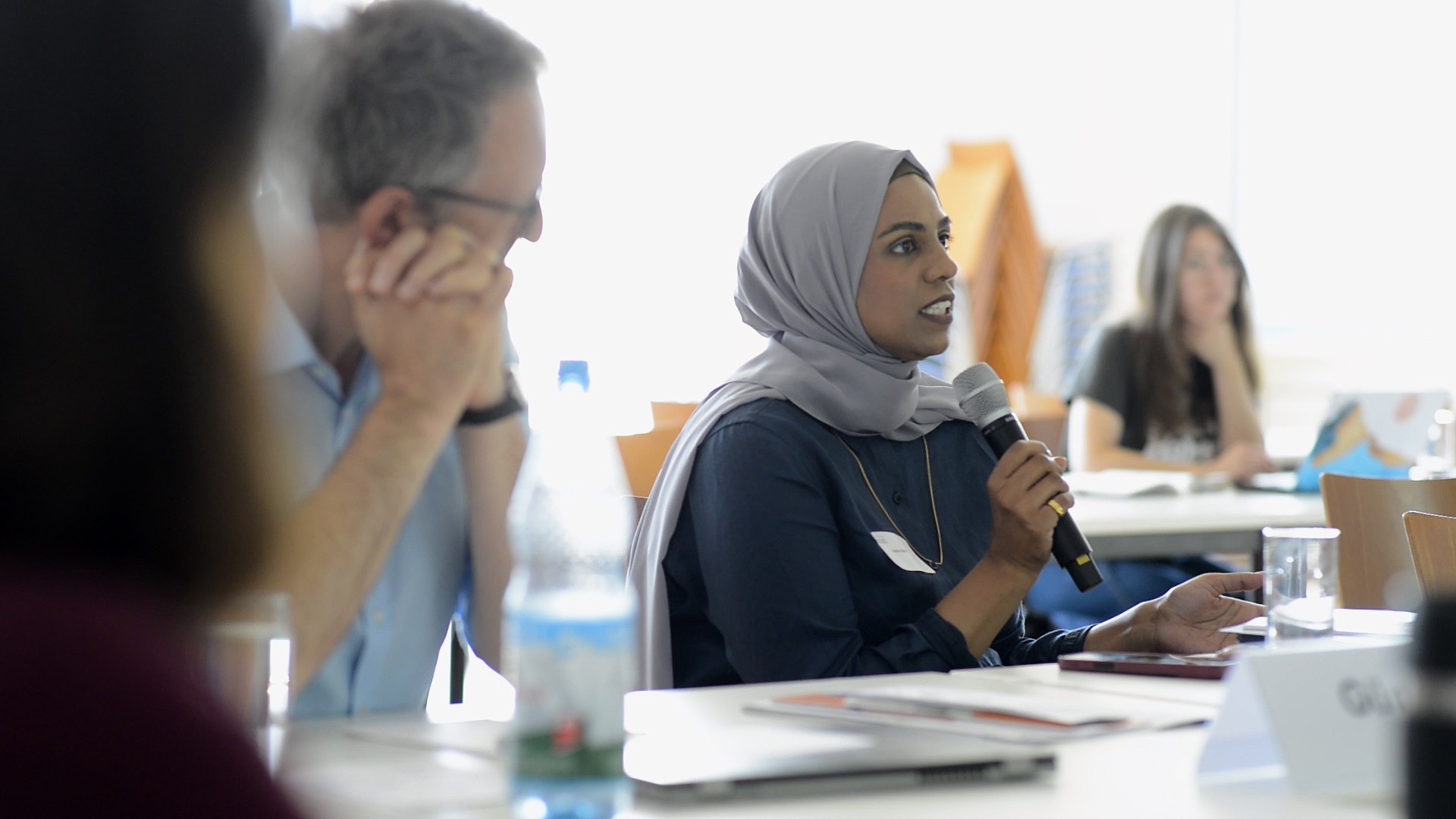
How do the ancient chains of transmission known from hadith literature look like when modelled as a digital network, and what happens to a historical narrative when it is shared and discussed on social media? These and similar questions were addressed at the international conference of the AIWG Research Group “Islam and Digitality” that took place at Goethe University Frankfurt in early July.
The conference focused on both the impact of digital spaces on cultures of remembrance, identities, and the resulting forms of community-building as well as the question whether and if so, how Islamic hermeneutics, religious authority, and practice are changing in the context of digital transformation.
In six thematically arranged panels around specific themes, the group’s researchers and twelve invited experts from universities in Germany, the United Kingdom, Israel, Iran, the USA, Singapore, and Indonesia presented their research on the role of increasing digitalisation in Islamic contexts. Contentwise, the program also reflected the international nature and diversity of the field. A wide variety of religious movements – ranging from the Ahmadiyya Muslim Jamaat and the Ismailis, from modern Sufi orders to Twelver Shia and Sunni groups – stood at the center of discussion. Geographically, the program considered the respective local contexts of Germany and Europe as well as West, South, and South-East Asia.
The conference was framed by two international keynotes. Professor Dr Sariya Cheruvallil-Contractor (Coventry University) presented the findings of several years of research into the interplay between digital and analogue Muslim life in comparative study of different European nations, addressing how digital behaviour of institutions and individuals is received by different age groups. Professor Dr Heidi Campbell (Texas A&M University) presented a new theoretical approach to understanding Islamic AI applications. In addition to their religious affordances, Campbell argues for taking into account their spiritual affordances. This theoretical approach, which focuses on the spiritual function, facilitates an interfaith comparison of Muslim, Christian, and Buddhist AI models – incidentally research on them forming the starting point for this approach.
A comprehensive conference report has been published here to document the findings. In addition, video recordings were made during the conference. These will soon become available in the form of a short film.
The collaborative project ‘Islam and Digitality’ is jointly implemented by researchers at Humboldt University of Berlin, Goethe University Frankfurt and the University of Erfurt.